2014-09-22

FT, Wolfgang Münchau: Italy debt burden is a problem for us all

 Wolfgang Münchau, FT

We need extreme and co-ordinated policy to make it possible for Italy to ultimately stay in the eurozone


Perhaps the biggest question facing the economic stability of Europe is what happens if Italy continues to stagnate as it had done for the past 15 years. Will everything just continue as it is now, just a little bit more depressed?

I think it is high time to address the consequences of failure with more clarity than is usually done. Put bluntly, Italy’s economic position is unsustainable and will result in eventual debt default unless there is a sudden and durable change in economic growth. At that point, Italy’s future in the eurozone would also be in doubt – and indeed the future of the euro itself.

What we are seeing in Italy is the brutal dynamics of debt deflation – where the fall in the price level raises the real value of debt. Between 2007 and 2013, the ratio of Italian public sector debt to gross domestic product rose from 103.3 per cent to 132.6 per cent according to Eurostat figures. For this year, the Organisation for Economic Co-operation and Development expects it to rise to 137.5 per cent.

If Italy continues to stagnate in 2015 and 2016, the debt-to-GDP ratio will be heading towards 150 per cent of GDP. /.../

We are in a situation where we need a lot of extreme and co-ordinated policy action to make it possible for Italy to grow, service debt and ultimately stay in the eurozone. But policy so far has been neither extreme nor co-ordinated. Matteo Renzi, Italian prime minister, has promised radical reform, but not yet delivered. However, this is not enough. Italian debt sustainability requires policies at eurozone level that have so far been ruled out. This is where the eurozone’s success or failure will be decided.
Jeigu Europoje ir toliau trūks ekonominės paklausos, didžiausia valstybės skola užsienio valiuta pasaulyje nebus sumokėta.

Eurozonos likimas spręsis Italijoje.

2014-05-19

Kaip gelbėjo eurą

Financial Times artėjančių rinkimų į Europarlamentą proga publikavo jaudinančią esė kaip Europos nomenklatūra "gelbėjo" zoną nuo suirimo.

Gelbėjo susitarę, kad krizės metu visokie statutiniai ir demokratiniai apribojimai neturi būti kliūtimi didžiam tikslui, todėl galima atlikti vieną kitą perversmą. Vokietija leido Europos centriniam bankui (ECB) vykdyti ekonomikos stabilizavimo veiksmus mainais už paramos gavėjų "struktūrinių reformų" kontrolę.

Sodrios detalės, neviešinti faktai, "žmogiškas veidas".
“Das ist nicht fair.” That is not fair, the German chancellor said angrily, tears welling in her eyes. “Ich bringe mich nicht selbst um.” I am not going to commit suicide.

For those who witnessed the breakdown in a small conference room in the French seaside resort of Cannes, it was shocking enough to watch Europe’s most powerful and emotionally controlled leader brought to tears.

But the scene was even more remarkable, those present said, for the two objects of her ire: the man sitting next to her, French President Nicolas Sarkozy, and the other across the table, US President Barack Obama.

It would be the low point in a brutal, recrimination-filled night, one many participants would recall as the nadir of the three-year eurozone crisis.
Nelengvas tai buvo procesas... Malonaus skaitymo.

2014-01-17

Demokratijos lopšyje

Graikija pirmininkauja Europos sąjungai.
Graikų premjeras Altonis Samaras vaiposi klausydamas, kaip Nigel Farage kalba apie Graikijos problemas, o patį vadina marionete.

Farage: We Are Now Run By Big Business, Big Banks and Big Bureaucrats

HT +Andrius Misevičius

2013-12-23

Antroji bankų sąjungos šuns koja

Senokai berašiau apie bankų sąjungą. Priminsiu kontekstą:
„Vienas didžiausių ES iššūkių – užtrukęs finansų sistemos susiskaidymas, neigiamai veikiantis ūkio raidą. Tik pašalinę jo priežastis, galėsime atkurti normalų finansų rinkos funkcionavimą ir taip paskatinti ekonomikos atsigavimą. Mūsų įsitikinimu, tai vienas iš svarbiausių Lietuvos pirmininkavimo tikslų, todėl šiandien ir rytoj vykstančiame susitikime išskirtinį dėmesį skirsime bankų sąjungos bei mažųjų ir vidutinių įmonių finansavimo klausimams“
... ponas Vasiliauskas gi nemeluos - negalėjo be bankų sąjungos būti normalaus finansų rinkos funkcionavimo. Labiau sofistikuotuose sluoksniuose buvo mėgstama pabrėžti, kad bankų sąjunga turėjo "to break the sovereign-bank feedback loop" - atskirti valstybių ir bankų krizes vieną nuo kitos.

Bankų sąjunga turėjo turėti tris kojas:
  1. ECB vykdomą centralizuotos bankų priežiūros mechanizmą,
  2. taisykles, ką veikti su "blogais" bankais,
  3. bendraeuropinį indėlių draudimo mechanizmą.
Ne paslaptis, kad vienas pagrindinių Lietuvos pirmininkavimo ES tikslų buvo rūpinimasis antrosios kojos sukūrimu.

Štai, sukūrė:


Trumpas angliškas aprašymas:
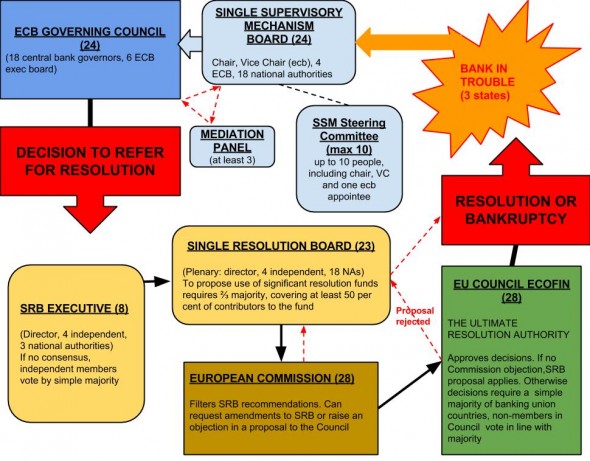
The decision making process will be thus: as supervisor the ECB recommends a bank be resolved, the board of national resolution authorities devises a plan and votes on it (any release of funds will require approval  two-thirds of voting countries contributing at least 50% of the common fund). This will then have to be approved by the Commission. If there is a dispute at any stage of this process the Council of EU finance ministers will decide on simple majority (if not then it will approve through a ‘silent procedure’).
... Visas pasaulis juokiasi.

Amerikoje FDIC banką penktadienį be įspėjimo uždaro, pirmadienį jis jau veikia kaip kito banko filialas. Balansus suvedinėja vėliau. FDIC turi neribotą FED kredito užnugarį.

Rusijoje "Nabiullina punches a red button and the bank drops through a hole in the floor" bankas sustabdomas "vienu CB vadovės mygtuko paspaudimu".

Lietuvoje sušaukiamas pasitarimas prokuratūroje, informacija nuteka, tai kitą dieną jau būna nutekėjęs banko likvidumas. Mes dar naujokai...

O Europoje bus vokiškoji biurokratinė romantika. Daugiapakopis demokratiškas pasitarimų ir derinimų kaip dalintis būsimus nuostolius darbas, apsimetant, kad tų nuostolių dydis žinomas iki perimant banką, informacija nenutekėjo ir nenutekės, o kai gražioji procedūra bus baigta, situacija banke bus tokia, kokia buvo viso to proceso pradžioje.

Visi supranta, kad absurdas, žino kaip reikia, bet daro kaip vokiečiai liepė - kad kol kas būtų gražu. Iki pirmo pritaikymo...

P.S. Dėl "mažųjų ir vidutinių įmonių finansavimo klausimų" kažkaip nieko perdaug nebesigirdėjo. Turbūt irgi išsprendė.

2013-12-08

Suzerenitetai (ES kritika britiškojo išskirtinumo dvasia)

Dešinysis euroskepticizmas apeliuojant į kultūrinį pranašumą - teisės viršenybę anglakalbių visuomenėse. Skamba visai įtikinamai, nes logikos trūkumą tekste kompensuoja iškalba.

2013.11.29 The Telegraph, Daniel Hannan: The single most objectionable thing about the EU (in a crowded field)
Shall I tell you the worst thing about the EU? It’s not the waste or the corruption or the Michelin-starred lifestyles of its leaders. It’s not the contempt for voters or the readiness to swat referendum results aside. It’s not the way that multi-nationals and NGOs and all manner of corporate interests are privileged over consumers. It’s not the pettifogging rules that plague small employers. It’s not the Common Agricultural Policy or the Common Fisheries Policy. It’s not the anti-Britishness or the anti-Americanism. It’s not even the way in which the euro is inflicting preventable poverty on tens of millions of southern Europeans.

No, it’s something more objectionable than any of these things – and something which, bizarrely, doesn’t exercise us nearly as much as it should. Put simply, it’s this: the EU makes up the rules as it goes along.

Just think, for a moment, about what that means. It means that any deal you’ve signed can be arbitrarily altered later. It means that any plans you’ve made, on the basis of what you took to be binding agreements, can be retrospectively destroyed. It means, in short, that there is no effective rule of law.

Consider one current example: a breach of the law so flagrant, so brazen, that it ought to stir a free people to revolt – and yet which has received only the paltriest attention.

When the European Constitution Lisbon Treaty was negotiated, Britain secured an opt-out from elements of it, notably the EU’s Charter of Fundamental Rights. This opt-out was no token. It was repeatedly described by ministers as a “red line”: an issue on which, in other words, they must get their way if they were to sign up to the treaty at all. The opt-out was brandished as a major victory for the Labour government. Indeed, the PM cited it in Parliament as a reason not to concede the public vote he had earlier promised.

Here is Tony Blair at the Despatch Box on 25 June, 2007:
It is absolutely clear that we have an opt-out from both the charter and judicial and home affairs. Those were the reasons why people like the right hon. Gentleman were saying that they wanted a referendum.
Pretty unequivocal, no? The EU’s human rights code would not be justiciable in the UK. Euro-judges wouldn’t be able to impose it on us. It didn’t take long for Brussels to go back on the deal. In a series of rulings, the European Court of Justice drew explicitly on the Charter to force its decisions on Britain.
Pateikia iškalbingą seriją tikrų ES statizmo faktų, tą dalį praleidžiu - skaitykite originale. Baigia:
Anglosphere exceptionalism is summed up in the words John Adams used when designing the Massachusetts state constitution: “a government of laws not of men”. Actually, the phrase wasn’t Adams’s: he was quoting a seventeenth-century English radical called James Harrington – a reminder of the deep roots of our shared Anglosphere liberties. But the point holds: the Anglosphere miracle lies in the elevation of the law above the state rather than the other way around. How sad that, debilitated by 40 years of EU membership, we appear to have dropped that principle.
Tekstas išimtinai apie suzerenitetą. Privilegiją valstybių lygmenyje kitiems primetinėti taisykles, kurių patiems laikytis galima tol, kol naudinga.

2013-11-06

Vokietijos atsakomybė

LEVY instituto post-keynesistai savaitgalį organizuoja konferenciją Atėnuose. Žiūrint į dalyvių sąrašą ir pranešimų temas, renginys bus turiningas. Temų ratas - nuo Vokietijos "nuopelnų" euro krizei aptarimo, iki pasidalinimo islandiškomis "kaip mes juos pasiuntėm ir nieko neatsitiko" patirtimis.

(Konferencijoje dalyvaus ir Már Guðmundsson, Islandijos centrinio banko vadovas. Skaitys pranešimą “Iceland’s Crisis and Recovery: Are There Lessons for the Eurozone and Its Member Countries?”)

Iš LEVY blogo kopijuoju Jörg Bibow interviu - pranešimo apie Vokietijos politikos klaidas anonsą.
You have been critical of German policy. How does it really affect the rest of Europe? In what ways does it cause harm to the peripheral economies?

Yes, indeed, German policy bears foremost responsibility for the euro crises and German policy is key to Europe’s future. Germany is Europe’s largest economy. For that reason alone whatever happens in Germany inevitably significantly impacts the eurozone economy. For instance, when Germany prescribed itself an extra dose of wage repression and fiscal austerity in the early 2000s, this had rather fateful consequences for the currency union. For one thing, stagnant domestic demand in Germany constrained its euro partners’ exports to Germany. For another, stagnation in Germany provoked some degree of monetary easing from the ECB, monetary easing which was both too little for Germany but too much for the euro periphery where wages and domestic demand were thereby propelled further. In other words, Germany undermined the ECB’s “one-size-fits-all” monetary policy stance. This happened alongside cumulative divergences in intra-area competitiveness positions, current account imbalances and the corresponding buildup in foreign asset and debt positions. Together this meant that the currency union was going to face trouble as soon as those imbalances would start to unravel. I started warning of these developments in 2005, but the euro authorities were sleeping at the wheel for many years to come.

This is the background to the still unresolved euro crisis, which is primarily a balance-of-payments and banking crisis that only became a sovereign debt crisis as a consequence. Adding insult to injury, the crisis has left Germany in the driver’s seat in eurozone policymaking. Germany punches above its weight in current policy debates. Unfortunately, in misdiagnosing the true nature of the crisis, Germany’s policy prescriptions have focused on nothing but fiscal austerity and structural reform. The consequences are proving a disaster for Europe. In particular, since Germany refuses to adjust its massive external imbalance and continues to have very low inflation, the ongoing rebalancing process inside the currency union is proving deflationary for everyone else. Essentially, as average eurozone wage and price inflation has fallen to extremely low levels, euro crisis countries are forced into debt deflation. Predictably, the wreckage is truly enormous. Policies and consequences are akin to what U.S. President Hoover and German Chancellor Brüning attempted in the 1930s. As we know, this sad experiment in macro policy folly gave the U.S. FDR, the New Deal, and Social Security, while outcomes in Germany were far less benign. It is as yet unclear which path Europe will take this time; the constructive or the destructive one.

What drives then Germany’s current policy? Doesn’t its leadership recognize the danger it poses for the future of the eurozone?

Confusion, a load full of ideological baggage, and short-sighted vested interests, I suppose. Apparently the German authorities do not understand the futility of their favored policies. My reading is that they have never quite understood that Germany could only succeed with its peculiar economic model in the past because and as long as its key trading partners behaved differently. Today Germany is forcing Europe to become like Germany. The trouble is of course that not everyone can be super-competitive and run perpetual current account surpluses at the same time. Somehow the German authorities are stuck in a deep ideological hole on this issue – and they keep on digging.

If Germany continues practicing its current policies, what would be the most likely outcome? Will we head towards the dissolution of the eurozone or with the permanent two- or even three-tier Europe and with the periphery in a quasi colonial situation?

Without a fundamental U-turn in Germany policy I expect the euro experiment, which has clearly failed at this point, to end in full-blown disaster: dissolution. Germany can only run perpetual current account surpluses vis-à-vis its euro partners with fiscal transfers as their counterpart. But such a “transfer union” is precisely what Germany dreads most. Somehow the German authorities, supposedly under pressure from Germany’s powerful export lobby, have trouble seeing the inevitable link between the two. Or perhaps they have convinced themselves that, as Germany’s euro partners become just like Germany, the eurozone as a whole can from now on run up a large external imbalance. If this is the new master plan, they are kidding themselves. The U.S. Treasury has just fired a broadside at Germany for this foolish endeavor, making it very clear that repeating at the global level the very strategy which has wrecked Europe was unacceptable [plačiau apie tai - čia]. Let me add that the Germany finance ministry’s response that Germany’s seven-percent-of-GDP current account surplus was neither a problem to Europe nor the world is truly scary, once again highlighting that the German authorities are bathing themselves in delusion and denial.
Išeitis iš politinio akligatvio, autoriaus nuomone, būtų bendro iždo, aprūpinamo finansiniais resursais per obligacijų emisijas, įgalioto vykdyti stambias investicijas visoje eurozonoje, sukūrimas.
I do believe however that my Euro Treasury plan features a minimalistic but functional fiscal union that would finally put the euro on a viable track.

By the way, Germany’s role in all this is not to embark on a national fiscal expansion. Germany’s own fiscal space is actually too limited for that and, while the markets may chose to ignore this fact at their peril, Germany is actually in an extremely vulnerable position itself. What we need from Germany is to emerge from its current state of delusion and denial, and to allow and facilitate the regime reforms needed to put the euro on a viable track. Without the Euro Treasury, the “strengthened” so-called Stability and Growth Pact and the “Fiscal Compact” are nothing but the euro’s deathtrap. By contrast, the Euro Treasury to-be turns the flawed project into a viable one. Needless to say, this would be in Germany’s own national interest, while, ultimately, its current policies are not. Germany has much to gain from a viable euro regime – just as breakup of the euro would prove extremely costly to Germany.
Techniškai įmanomas planas, politiškai dar ne.

Papildymas. Žiū, visai linksma "vokiečių atsakomybės" polemika. Brussels Blog:
2013.11.11 Rehn siding with Washington in its battle with Berlin?
Over the last few weeks, the normally über-dismal science of German economic policymaking has unexpectedly become stuff of international diplomatic brinkmanship, after the US Treasury department accused Berlin of hindering eurozone and global growth by suppressing domestic demand at a time its economy is growing on the backs of foreigners buying German products overseas.

The accusation not only produced the expected counterattack in Berlin, but has become the major debating point among the economic commentariat. Our own Martin Wolf, among others, has taken the side of Washington and our friend and rival Simon Nixon over at the Wall Street Journal today has backed the Germans.

Now comes the one voice that actually can do something about it: Olli Rehn, the European Commission’s economic tsar who just made his views known in a blog post on his website. Why should Rehn’s views take precedence? Thanks to new powers given to Brussels in the wake of the eurozone crisis, he can force countries to revise their economic policies – including an oversized current account surplus – through something soporifically known as the Macroeconomic Imbalance Procedure.
2013.11.13 Rehn, Germany and US Treasury Dept: Round Two (Ko tie amerikonai kabinėjasi?)

OpenEurope, 2013.11.13 Reviewing Germany's surplus
Signs on this front so far show the potential for conflict. German reactions have already been quite hostile with CSU General Secretary Alexander Dobrindt warning that, “You don't strengthen Europe by weakening Germany” and CDU General Secretary Hermann Gröhe adding, “Our export strength is the corner stone of our prosperity”. Bundesbank President Jens Weidmann added that expanding Germany fiscal policy is also not the answer, saying, “The positive knock-on effects would be limited”.

2013-09-27

Versalio dvasia

Italų ekonomistai Emiliano Brancaccio ir Riccardo Realfonzo pirmadienį FT paskelbė atvirą laišką-įspėjimą apie "taupymo politikos" (austerity) keliamą grėsmę eurozonai - The economists' warning.

Parašai kaupiasi. Cituoju paskutines pastraipas:
John Maynard Keynes opposed the Treaty of Versailles in 1919 with these far-sighted words: “If we take the view that Germany must be kept impoverished and her children starved and crippled […] If we aim deliberately at the impoverishment of Central Europe, vengeance, I dare predict, will not limp.” Even though the positions are now reversed, with the peripheral countries in dire straits and Germany in a comparatively advantageous position, the current crisis presents more than one similarity with that terrible historical phase, which created the conditions for the rise of Nazism and World War II. All memory of those dreadful years appears to have been lost, however, as the German authorities and the other European governments are repeating the same mistakes as were made then. This short-sightedness is ultimately the primary reason for the waves of irrationalism currently sweeping over Europe, from the naive championing of flexible exchange rates as a cure for all ills to the more disturbing instances of ultra-nationalistic and xenophobic propaganda.

It is essential to realise that if the European authorities continue with policies of austerity and rely on structural reforms alone to restore balance, the fate of the euro will be sealed. The experience of the single currency will come to an end with repercussions on the continued existence of the European single market. In the absence of conditions for a reform of the financial system and a monetary and fiscal policy making it possible to develop a plan to revitalise public and private investment, counter the inequalities of income and between areas, and increase employment in the peripheral countries of the Union, the political decision makers will be left with nothing other than a crucial choice of alternative ways out of the euro.

2013-09-23

Lenkijos ekonomistai: Eurozona kelia pavojų Europos sąjungai


eurointelligence.com: A Polish central bank working paper proposes dissolution of eurozone
Working papers do not reflect the views of monetary policy committees of central banks, but central banks usually makes sure that the papers are not openly contradicting their own message. We are just wondering what the purpose is behind this paper by Stefan Kawalec and Ernest Pytlarczyk, entitled: Controlled dismantlement of the Eurozone, A proposal for a New European Monetary System and a new role for the European Central Bank. The authors are a former deputy finance minister and a chief economist of Commerzbank subsidiary. They argue the eurozone was now threatening the EU, as it is unrealistic to believe that the current austerity policies are likely to work. Defending the euro at all costs may lead to political collapse, and a disorderly breakup. Their proposed alternative is for the euro to remain the currency of the least competitive countries, with the strong countries to leave first – to be followed by a new system of currency co-ordination.

(Dėl kažkokių naujienų agentūros tinklapio keistenybių negaliu pasinaudoti "Share" funkcija, nei sukurti tiesioginės nuorodos į pranešimą). 

2013-09-21

Mark Blyth apie "atsakingąjį taupumą" ir bankų problemas

"Atsakingo taupymo politika" skurdina ekonomikas, o skurdas kerta per realiąją visų privačių finansinių aktyvų vertę. Nuvertėjantys aktyvai kiurdo bankų balansus.

Nemoki finansų sistema svirduliuoja ant bankų panikos ribos. ECB likvidumo operacijos gelbsti, bet problemos nesprendžia.

Tradicinio bankų krizių sprendimo metodo - totalinės fiskalinio suvereno garantijos - eurozona taikyti negali, nes fiskalinio suvereno tiesiog nėra. Niekas neįgaliotas "spausdinti pinigų" tiek, kiek reikia. Faktiškai, toli viršydamas savo įgaliojimus, remdamasis instituciniu autoritetu, tai galėtų daryti nebent ECB, bet "pliusinių" valstybių rinkėjai sužinoję nustebtų.

Galima garantijų sistemą kurti slapta, "už balansų", bet neįgaliotų asmenų slaptų garantijų patikimumas abejotinas.

Eurozona turi struktūrinę problemą.
---

Pasakyti dalykai yra tik kuklus komentaras Mark Blyth valandos paskaitai Google. Lektorius charizmatiškas, šneka tiesi. HT +Arijit Banik.


YouTube esama trumpesnių Mark Blyth įrašų.

2013-09-14

Nausėdai: euras - kaip trijų metrų gylio duobė

SEB banko prezidento patarėjas Gitanas Nausėda „Žinių radijo“ laidoje „Atviras pokalbis“ teigė, kad šalies politikų neapsisprendimas dėl euro įvedimo gali brangiai kainuoti.
„Mes įsivaizduojame, kad euro įvedimas yra, jeigu kalbant krepšinio terminais, kažkoks trijų metrų skersmens krepšinio lankas, į kurį kamuolį gali įmesti bet kada. Šiandien nenoriu, įmesiu rytoj... Bet juk taip nėra. Mes šiuo metu turime tikrai labai neblogas sąlygas patekti į euro zoną tiek dėl infliacijos, tiek dėl valstybės skolos, tiek dėl net biudžeto deficito, o rytoj nėra jokių garantijų, kad pasaulyje infliacija neišaugs, Europoje infliacija neišaugs, Lietuvoje infliacija neišaugs... Ji gali išaugti ir mums gali būti labai sunku į tą korsetą įsisprausti 2015 ar 2016 m.“, – perspėjo G.Nausėda.
Perfrazuodamas Gitaną Nausėdą vairavimo terminais, verčiau siūlau eurą įsivaizduoti kaip trijų metrų gylio duobę, kurią kelyje reikia atsargiai apvažiuoti. Nebent trokštume ateities, kurioje vietoje demokratijos būtume "krizės svertais" vairuojami puse lūpų kalbančių ECB statytinių.

Kalbėdamas apie eurozonos bėdas, britų laikraščio Daily Telegraph apžvalgininkas Ambrose Evans-Pritchard paminėjo šiemet italų kalba išleistą knygą "Morire di Austerita". Knygos autorius Lorenzo Bini-Smaghi iki 2011-ųjų lapkričio buvo aukščiausio lygio ECB funkcionieriumi - priklausė ECB vykdomosios tarybos šešetui.
Citata nuo knygos viršelio: "La crisi è soprattutto politica. Riflette l’incapacità delle democrazie occidentali di risolvere problemi accumulati da oltre un ventennio. Chi è eletto democraticamente fa fatica a prendere decisioni impopolari che possono comprometterne la rielezione. L’emergenza diventa così il motore dell’azione politica e il modo per giustificare le manovre correttive di fronte agli elettori, con la conseguenza che la cura - tardiva e varata sotto la pressione dei mercati - diventa ancor più dolorosa e impopolare."

Vertimas (ačiū už pagalbą +Agne Ma): Krizė yra visų pirma politinė. Ji demonstruoja vakarietiškų demokratijų nesugebėjimą spręsti daugiau nei dvidešimt metų besikaupiančias problemas. Demokratiškai išrinktos vyriausybės nesugeba daryti nepopuliarių sprendimų, kurie galėtų neigiamai įtakoti perrinkimą. Todėl krizė tampa politiniu stimulu ir būdu pasiteisinti prieš rinkėjus dėl korekcinių manevrų, duodančių reikiamą rezultatą. Bet pavėluotai, rinkų spaudimo fone vykdomos priemonės būna dar skausmingesnės ir nepopuliarios.
Knyga pateikia problemų, kurių tos "neefektyvios" demokratijos nesugeba "išspręsti", paaiškinimą: Target2 (centrinių bankų tarpusavio garantijų sistemos) disbalansai. Kitaip - pati eurosistemos esmė. Pasirodo, buvusio ECB vykdomosios tarybos nario nuomone, tai "demokratijos problema" ir ją leidžiama spręsti, "spaudžiant krizės svertus".

Kapitalas (bankų įsipareigojimai eurais) eurozonoje, žinote, turi "mobilumo teisę". O patys bankai gali įsipareigoti, kaip tik jiems šauna į galvą. Pavyzdžiui banką valdantys asmenys per statytinius gali įsipareigoti patys sau. Jei nori, gali tą įsipareigojimą perkelti į bet kurį kitą eurozonos banką (pervesti pinigus). Pervedimui įvykus, valstybės balansas Target2 sistemoje pablogėja visa to pervedimo suma. O valstybės, į kurią pinigai "nuėjo", "pagerėja".

(Jeigu toks bankas nusprogtų, ir paaiškėtų, kad pusė jo aktyvų fiktyvūs, anuliuoti tokios operacijos, nepasibylinėjus kelių valstybių teismuose, nebūtų įmanoma.)

Centrinio banko funkcionieriaus politikos supratimas toks: įsiskolinimai, atsirandantys per Target2 tvarkant neaišku kokius reikalus bankams su neaišku kokiais balansais [dar vienas "balansų skylės" paaiškinimas čia], turi būti "aptarnaujami" realaus ekonominio produkto, realios vertės srautais. Politikai privalo tai iš savo ekonomikų išspausti.

Ir apie tai neturi būti viešai kalbama kitaip, kaip apie fiskalinę drausmę. Rekomenduojama reklamuoti būsimą "bankų sąjungą", būsimą bankų priežiūros mechanizmą, būsimą garantinį fondą į kurį per dešimt metų gal bus surinkta 50 milijardų eurų.

Kam nepatinka - pats kaltas. Knygoje atskleidžiami ECB Italijoje inicijuoto politinio perversmo, įvykdyto Berlusconi 2011-aisiais pradėjus konsultacijas dėl Italijos išstojimo iš eurozonos, faktai.

Visų eurozonos šalių Target2 įsipareigojimai Vokietijai - virš pusės trilijono eurų, bankų sistemos balansų skylė - dar ne mažiau trilijono. Knygoje aprašomas epizodas, kaip 2012-aisiais Vokietijos kanclerė Merkel jau buvo susiruošusi išmesti Graikiją iš eurozonos, bet išgirdus paaiškinimą, kokios bus grandininės bankrotų reakcijos, ir kas galiausiai turės mokėti, persigalvojo. Rizika ir įtampos susidarė tokios, kad Target2 prižiūrėtojai Vokietijoje "naktimis nebemiega".

Kadangi tie įsipareigojimai kolektyviniai [dar vienas paaiškinimas čia], Vokietijai palanku, kai juos prisiima daugiau šalių. Kaip ne keista, tai palanku ir naujai prisijungiančiųjų narių elitams.

Propagandos mašinos įjungtos. Bankininkai juodais kostiumais Lietuvoje:
V. Vasiliauskas: neturime teisės dar kartą paleisti vėjais galimybės įsivesti eurą;
G. Nausėda: euro [neįvedimo] klausimas Lietuvai gali brangiai kainuoti;

bet... Vasiliauskas: krizė atskleidė finansų sistemos spragas

Gal manote, kad ponas Vasiliauskas kalba apie sistemines spragas? Besąlygines garantijas, tik po dešimties metų sugalvojant, kad tų garantijų galutiniai naudotojai - bankai - turėtų būti išties, o ne formaliai kontroliuojami?

Žinoma, ne. Spręskite patys:
Pono Vasiliausko teigimu, Europai būtinas toks finansų priežiūros ir reguliavimo priemonių rinkinys, kuris ne tik sustiprintų finansų sistemą, bet ir paskatintų ekonomikos, ypač smulkiojo ir vidutinio verslo, finansavimą.

„Vienas didžiausių ES iššūkių – užtrukęs finansų sistemos susiskaidymas, neigiamai veikiantis ūkio raidą. Tik pašalinę jo priežastis, galėsime atkurti normalų finansų rinkos funkcionavimą ir taip paskatinti ekonomikos atsigavimą. Mūsų įsitikinimu, tai vienas iš svarbiausių Lietuvos pirmininkavimo tikslų, todėl šiandien ir rytoj vykstančiame susitikime išskirtinį dėmesį skirsime bankų sąjungos bei mažųjų ir vidutinių įmonių finansavimo klausimams“, – pranešime cituojamas Lietuvos banko valdybos pirmininkas.
Ambrose Evans-Pritchard žodžiais:
He [Lorenzo Bini-Smaghi - ed.] confirms that Germany is indeed on the hook for €574bn of credits from the Bundesbank to the central banks of Greece, Portugal, Ireland, Italy, Cyprus, and Slovenia.

We have always been assured that the so-called Target2 credits within the ECB's internal payments system is a technical adjustment, without significant risk.

Mr Bini-Smaghi states that any EMU state leaving the euro would face likely default on external obligations. "The national central bank would not be able to repay liabilities accumulated in relation to other members of the euro system, which are registered in the internal payments system of the Union (known as Target2). The insolvency would provoke substantial losses for counter-parties in other eurozone countries, including central banks and states." [...]

This means that if the euro blows up, the Bundesbank still owes this money to the same private banks, which could be Deutsche Bank, but could also be Nomura, Citigroup, or Barclays. This is not fictitious. The Bundesbank cannot default on these securities.

Perhaps I am a bear of very little brain, but I have yet to hear a satisfactory explanation as to how this can be conjured away painlessly, as we are told by a long list of illustrious economists that it can be. I have never seen them answer this issue. They publish long papers, blinding everybody with science as economists are prone to do (usually bluffing), but never get to the core point.

The fact is that Target2 is the flipside of intra-EMU capital flight. Private investors have pulled out of Club Med, dumping their claims onto the taxpayers of Germany and the northern creditor states. Dress this up any way you want, but that is the reality.

Yes, the Bundesbank could print money with gay abandon in such a crisis – and would have to do so to avoid a deflationary shock, and on a much larger scale than anything suggested so far within the EMU construct. Germany would no doubt muddle through, but its monetary doctrines would be shredded.

The Bundesbank's official position is that the Target2 controversy is a storm in a teacup. In fact, they don't believe it themselves. A Bundesbanker with direct responsibility for Target2 said in my presence that he "worries about it every night". The bank's own president Jens Weidmann testified last year that the imbalances are an "unacceptable risk".

I suspect that somebody is trying to pull the wool over the eyes of the German people, and it is not the splendidly outspoken Jens Weidmann.
---
Brad DeLong:
No mystery, guys; you messed up.

2013-09-02

Kaip Schäubl'ienė demokratiją atstatė

Formavosi nuomonė, kad vardan šventos ramybės Vokietijoje iki rinkimų bus vengiama rimtų diskusijų apie Graikiją. Rinkėjams tereikėjo žinoti , kad "krizė pasibaigė", kadangi "Merkel suvaldė situaciją".

Jei ne bendražygio žmona...
Schäuble, on the other hand, is clearly pleased with his image as an honest champion of the truth. Last Thursday, he spoke to supporters at the Maria Laach monastery in the western Eifel region. His listeners wanted to know what had prompted him to make the statement about Greece.

He is always a little cranky in the morning, the minister replied. And he was in one of those moods at breakfast recently, he added, when his wife asked him what was going on with Greece and whether there would be any nasty surprises after the election. "After the election? Well, everything we already know and that's already been decided," the minister replied. "If my wife is asking," he said, to the amusement of his audience, "I have to set things straight."
Toks vat konfūzas gavosi. (Schäuble - dabartinis Vokietijos finansų ministras). Dabar Merkel tenka teisintis dabatuose. Ir per reitingą kaukštelėjo.
Electionista: Germany - Infratest dimap poll - preferred Chancellor: Angela Merkel (CDU) 48%(-6 from pre-debate), Peer Steinbrück (SPD) 45%(+17)
Užtat demokratija.

Electionista puikus informacijos šaltinis, ir Wikipedijos puslapis skirtas Vokietijos rinkimams, ir viešosios nuomonės duomenų puslapis.

2013-08-13

Vokiškas bėdavojimas: norėtųsi daugiau demokratijos - niekas nepaduoda

Jürgen Habermas SPIEGEL'yje sako, kad Eurozona ir Vokietija indoktrinuotos iliuzijomis, kurių palaikymas nelabai dera su demokratija. Esą derėtų diskutuoti nepopuliarius dalykus rinkimų kampanijos metu, o ne tada, kai jau šaukštai bus po pietų.

Merkel's European Failure: Germany Dozes on a Volcano
In the name of market imperatives to which there is allegedly no alternative, an increasingly isolated German government is enforcing harsh austerity policies in France and those euro-zone countries gripped by crisis. Contrary to reality, it assumes that all members of the European monetary union can make their own decisions regarding budgetary and economic policy. They are expected to "modernize" their administration and economy, and to enhance their competitiveness on their own -- if necessary with aid loans from the rescue fund.

This fiction of sovereignty is convenient for Germany, because it saves the stronger partner from having to take into account the negative effects that some policies can have on weaker partners. It is a situation that European Central Bank President Mario Draghi warned about a year ago, saying that "it is neither sustainable nor legitimate for countries to pursue national policies that can cause economic harm for others" (Die Zeit, Aug. 30, 2012).

It's worth repeating again and again: The suboptimal conditions under which the European Monetary Union operates today are the result of a design flaw, namely that the political union was never completed. That's why pushing the problems onto the shoulders of the crisis-ridden countries with credit financing isn't the answer. The imposition of austerity policies cannot correct the existing economic imbalances in the euro zone. An assimilation of the different levels in productivity in the mid-term could only be expected from a joint, or at least closely coordinated, fiscal, economic and social policy. And if we then, in the course of countervailing policies, don't wish to completely turn into a technocracy, we must ask the public what they think about a democratic core Europe. Wolfgang Schäuble knows this. He says as much in SPIEGEL interviews, which, however, have no consequences for his political behavior.

European policy is in a trap that the political sociologist Claus Offe has sharply illuminated: If we do not want to give up the monetary union, an institutional reform, which takes time, is both necessary and unpopular. This is why politicians who hope to be re-elected are kicking the can down the road [...]

On the other hand, what exactly does "unpopular" mean? If a political solution is sensible, it should be reasonable to ask a democratic electorate to accept it. And when should one do so, if not before a parliamentary election? Anything else is patronizing deception. It is always a mistake to underestimate and ask too little of voters. I consider it a historical failure of the political elites in Germany if they continue to shut their eyes and behave as if it were business as usual -- that is, if they persist in their shortsighted wrangling over the fine print behind closed doors, which is the current approach.

Instead, politicians should come clean with the increasingly restless citizenry, which has never been confronted with substantial European issues. They should take the lead in an inevitably polarizing dispute over alternatives, none of which is available for free. And they should no longer remain silent about the negative redistribution effects, which the "donor countries," in their own long-term interest, must accept in the short and medium term as the only constructive solution to the crisis.
Tekste trūksta problemų masto, atstovaujamų interesų įvardinimo. Tarsi būtų kalbama apie nedidelius reglamento pažeidimus, rutinines politios problemėles.

Kokia žurnalistika, tokia ir politika.
---
[Papildau] Germans Believe Politicians Are Lying About Crisis, Says Study (blogs.wsj), The Missing Truth in the German Campaign (editors.bloomberg)

2013-08-05

Open Europe apie bankų sąjungą

Pro-europinis britų Open Europe institutas (think tank) dar 2013.07.10 skelbė verdiktą kuriamai bankų sąjungai:
The banking union is likely to form an important part of any solution to the eurozone crisis (if one can be found) and the SRM is a vital pillar of this. However, the Commission’s proposal as it stands is likely too small, will not be implemented soon enough and suffers from significant political opposition. It does not therefore have a realistic chance of ending the financial fragmentation plaguing the eurozone. Furthermore, it also stretches the limits of the EU treaties, setting a worrying precedent for the UK and other non-eurozone countries as it poses the risk that single market treaty articles can be used for purely eurozone ends. Even Germany has insisted that such a far-reaching proposal which effectively alters the eurozone architecture requires treaty change, be it now or in the future. The eurozone is yet to face up to the fundamental problem of reconciling the economic realities within the existing legal and political limits – this proposal is another example of attempting to circumvent them in another ad-hoc way. As long as this approach continues uncertainty will plague the eurozone.
New Open Europe flash analysis: Controversial second pillar of banking union looks insufficient to hold up eurozone roof in a crisis

Korektišku tonu ir labai dalykiškai paaiškinta, kad kuriama bankų sąjunga yra tik pirmas netvirtas žingsnis link didelės problemos sprendimo. Dar net neaišku, ar tą mažą, toli gražu problemų nesprendžiantį mechanizmą pavyks sukurti apskritai.

Apie garantinio fondo dydį:
A Single Bank Resolution Fund (SBRF) will be set up and will equal 1% of insured deposits in the banking union, around €55bn. This will be built up by bank contributions over the course of 10 years. How much and how each bank will contribute is yet to be defined and may be set out in Commission delegated acts. This is a worrying precedent since it provides a significant amount of power to set the scope and nature of a financial levy to the Commission without significant oversight.

As of May 2013, bank assets in the EU totalled €45 trillion, while in the eurozone they totalled €32.5 trillion – this is equal to 349% and 342% of GDP respectively.

Clearly, given the size of the banking sector this backstop seems short of being the necessary size. We have previously estimated that a fund would need to be around €500bn to €600bn to provide a viable backstop for a banking sector this size (in line with international comparisons and standards). Importantly, most resolution funds are backed by a credit line or implicit guarantee from a treasury or national central bank. Absent this, serious questions remain over the viability of the fund and the SRB to act swiftly during a crisis.

Under the EC plans “no explicit” role is given to the ESM, the eurozone bailout fund, which now has the ability to directly recapitalise banks using up to €60bn. This provides a further buffer, but given the significant hurdles to its use and the strict conditions, it seems unlikely to be tapped in anything but the worst crisis (as we have already noted).

Bail-in plans bear most of the burden under the banking union: A significant amount of emphasis is being put on the bail-in plans to bear the brunt of a resolution process. It is clear that a lower taxpayer burden is desirable. That said, the knock-on effects could be painful for the eurozone in terms of higher bank funding costs. Furthermore, the potential for contagion in a crisis is clear.

Meanwhile, given the size of these funds relative to national banks, it is unlikely to be sufficient to break the sovereign banking loop, not least because bail-ins on domestically focused banks will have a significant impact on the national economy (still the purview of national governments).
Kiti klausimai (analizės turinys):
1. Where does the power lie?
2. Will the resolution fund be large enough to backstop the €33 trillion eurozone banking sector?
3. Will the SRM be able to put the banking sector on “sounder footing, restore confidence and overcome fragmentation in financial markets”?
4. Will it require treaty change?
5. Germany has come out swinging
6. How could this impact the UK and non-eurozone countries?
Must-read.

2013-07-26

Ellen Brown apie Europos bankų atsakomybės slinktį

by Ellen Brown
Think Your Money is Safe in an Insured Bank Account? Think Again.
When Dutch Finance Minister Jeroen Dijsselbloem told reporters on March 13, 2013, that the Cyprus deposit confiscation scheme would be the template for future European bank bailouts, the statement caused so much furor that he had to retract it. But the “bail in” of depositor funds is now being made official EU policy. On June 26, 2013, The New York Times reported that EU finance ministers have agreed on a plan that shifts the responsibility for bank losses from governments to bank investors, creditors and uninsured depositors.

Insured deposits (those under €100,000, or about $130,000) will allegedly be “fully protected.” But protected by whom? The national insurance funds designed to protect them are inadequate to cover another system-wide banking crisis, and the court of the European Free Trade Association ruled in the case of Iceland that the insurance funds were not intended to cover that sort of systemic collapse.
Shifting the burden of a major bank collapse from the blameless taxpayer to the blameless depositor is another case of robbing Peter to pay Paul, while the real perpetrators carry on with their risky, speculative banking schemes [...]

Although the bail-in template did not hit the news until it was imposed on Cyprus in March 2013, it is a global model that goes back to a directive from the Financial Stability Board (an arm of the Bank for International Settlements) dated October 2011, endorsed at the G20 summit in December 2011. In 2009, the G20 nations agreed to be regulated by the Financial Stability Board; and bail-in policies have now been established for the US, UK, New Zealand, Australia, and Canada, among other countries. (See earlier articles here and here.)

The EU bail-in plan, which still needs the approval of the European Parliament, would allow European leaders to dodge something they evidently regret having signed, the agreement known as the European Stability Mechanism (ESM). Jeroen Dijsselbloem, who played a leading role in imposing the deposit confiscation plan on Cyprus, said on March 13 that “the aim is for the ESM never to have to be used.”

Passed with little publicity in January 2012, the ESM imposes an open-ended debt on EU member governments, putting taxpayers on the hook for whatever the ESM’s overseers demand. Two days before its ratification on July 1, 2012, the agreement was modified to make the permanent bailout fund cover the bailout of private banks. It was a bankers’ dream – a permanent, mandated bailout of private banks by governments. But EU governments are now balking at that heavy commitment.

In Cyprus, the confiscation of depositor funds was not only approved but mandated by the EU, along with the European Central Bank (ECB) and the IMF. They told the Cypriots that deposits below €100,000 in two major bankrupt banks would be subject to a 6.75 percent levy or “haircut,” while those over €100,000 would be hit with a 9.99 percent “fine.” When the Cyprus national legislature overwhelming rejected the levy, the insured deposits under €100,000 were spared; but it was at the expense of the uninsured deposits, which took a much larger hit, estimated at about 60 percent of the deposited funds [...]

While the insured depositors escaped in Cyprus, they might not fare so well in a bank collapse of the sort seen in 2008-09 [...]
Vienintelis įmanomas bankų "stabilumo mechanizmas" Europoje yra ECB.

Bet ne kontrolės. Pradinis bankų sąjungos planas ir buvo tas dvi funkcijas - draudimą ir kontrolę sujungti po ECB stogu, taip sukuriant vieningą pajėgią europinę bankų sistemą. Tai būtų buvusi grandiozinė reforma su savo politiniais pavojais, kurie visiems pasirodė per dideli.

Todėl konstruojamas simuliakras - pusiau Kipro, pusiau Islandijos pusiau rogės, pusiau vežėčios. Raminančios propagandinės pasakos fone nebaigtą konstrukciją tempia pavargusios ekonomikos kuinas, nors girgžda, bet važiuoja. Iki nuokalnėlės.

2013-07-25

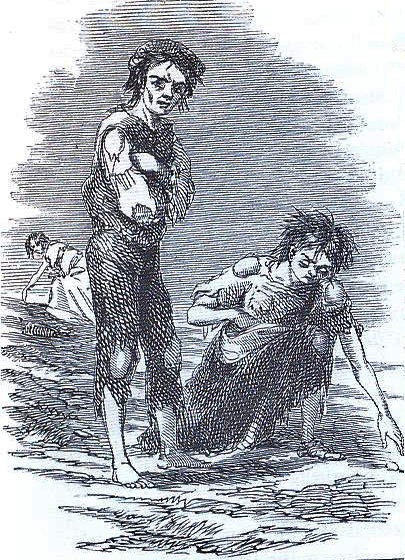
Overpopulation. Airijos bulvių badas


1799 m. Airija prisijungė prie Didžiosios Britanijos ir pagaliau tapo pilnaverte Jungtinės Karalystės nare.
The passage of the Act in the Irish Parliament was ultimately achieved with substantial majorities, having failed on the first attempt in 1799. According to contemporary documents and historical analysis, this was achieved through a considerable degree of bribery, with funding provided by the British Secret Service Office, and the awarding of peerages, places and honours to secure votes.[51] Thus, Ireland became part of an extended United Kingdom, ruled directly by a united parliament at Westminster in London.
1826 airiai atsisakė nuosavos valiutos. Ekonomika nori nenori turėjo atsakingai susiorientuoti į eksportą. Anglams reikėjo mėsos.

Airijos žemvaldžiams tapo naudinga žemę skirti į eksportą orientuotai gyvulininkystei, todėl nuo geriausių žemių nuvarė nuomininkus, kuriems teko susispausti į pakraščius. Likę ant mažesnių žemės sklypų žmoneliai skurdo ir priverstinai koncentravosi į to, kas būtiniausia prasimaitinimui - bulvių auginimą. 1845-aisias prasidėjus potato blight epidemijai, maždaug trečdalis airių (apie trys milijonai žmonių) mito vien bulvėmis. Milijonas išmirė badu, milijonas emigravo. Airija prarado 20-25% gyventojų.

Ne tai, kad būtų stokoję žemės kitokio maisto užauginimui ir žmonių išmaitinimui. Institucinė struktūra neleido.

Nathan Tankus: Marx on Ireland, Then and Now
Ireland’s experience in the 19th century has implications not only for today, but specifically for modern Ireland. Ireland never really recovered from the great famine. It had net emigration for the rest of the 19th century and most of the 20th century. According to Martin Ruhs of University of Oxford: “In 1996, Ireland reached its migration ‘turning point,’ making it the last EU Member State to become a country of net immigration”. With the onset of the Euro crisis, unemployment in Ireland reached well above 10% and stayed there. As a result, net emigration has returned to Ireland according to the last migration estimates produced by the Central Statistics Office (click to enlarge).

Thus, in Marx’s language, Irish and Eurozone policy has produced a “relative surplus population” and reproduced the conditions which led to net emigration Ireland. The difference is largely in the fact that now Ireland has a social safety net. This may not be true for long, as Ireland implements budget cut after budget cut as the “powers that be” demand. Rather than being pushed by the British however, this austerity is being pushed by the Eurozone and the IMF. Just last week, according to the Irish Examiner,
The International Monetary Fund said Ireland should stick to the terms of the bailout agreement and cut €3.1bn from the Budget in October. The IMF said it was not its job to dictate the terms of the Budget, but said that Ireland needed to continue its track record of fiscal consolidation”.
In other words, the blood-letting continues.

Finally, for those watching the history of currency unions closely, it is interesting to note that the Irish pound was ended in 1826. One major (albeit dated) study of Irish economic history argues that “the suppression of paper money in 1826 the tragic effects of the Great Famine twenty years later were made inevitable”. If this latter point about the Irish pound is true, it implies that Ireland has fallen into another trap similar to the one that plagued it in the 19th century. The difference is that this time Ireland’s politicians gave up autonomy rather then having it yanked from them. Words such as tragedy and farce don’t begin to describe their crisis.

2013-07-24

Optimistė

Grybauskaitė: Bankų sąjunga sustiprins ES vidaus rinką
Kuriama Europos Sąjungos (ES) Bankų sąjunga leis atkurti pasitikėjimą bankais, pagerins bankų priežiūrą bei užkirs kelią krizėms, kylančioms dėl bankų pažeidžiamumo, teigia prezidentė Dalia Grybauskaitė.

[...] „Tarp svarbiausių Lietuvos pirmininkavimo darbų - stiprinti finansų sektorių, toliau kuriant Bankų sąjungą. Viena iš sudėtinių jos dalių - bendras bankų pertvarkymo mechanizmas, kuris leistų lengviau valdyti bankų krizes ateityje. O bankams susidūrus su sunkumais, jo pertvarkymo kaštus prisiimtų patys bankai ir taip būtų apsaugomi mokesčių mokėtojų pinigai bei sumažinta grėsmė viešiesiems finansams“
Taip ir bus. Pasimelskime
[...] the fact that there is no plan B tells us that the real reason we are doing this lies elsewhere, which is to be found in the overleveraged European banking system, which is stuffed with bad assets and its too big to Bail. Given that no state, even Germany, is big enough to solve the problem of removing these bad assets from the banking system, they squeeze, add liquidity, and pray. 
Visi viską kuo puikiausiai supranta.
FT Alphaville: A banking union “no go” summary
Bloomberg: How to Kill a Banking Union the German Way
FT: The dangers of Europe’s technocrats

2013-07-23

Beveik euro optimistas Mark Blyth

Optimistai galvoja, kad jeigu žiaurosistema taptų netvari, elektoriatas ką nors nubalsuotų geriau. Miela iliuzija
Is it the notion of the “new normal” which retains the politicians and mainstream economist to realize that austerity has failed?
If the “new normal” is a permanent unemployment rate of 20 percent and the constant destruction of productive capacity, then the new normal will not be normal very long. At the end of the day you can’t run a gold standard type if monetary regime, which is what the Euro is in that no one can create the currency that they use and so deprived of inflation and devaluation as options the adjustment to shocks occurs entirely through wages and prices, in a democracy. Eventually someone will vote against it, and at that point the entire project can unravel. 
Nereikėtų turėti iliuzijų dėl tų demokratijų. Bet respect' Mark'ui už idealizmą.

2013-07-12

Ambrose Evans-Pritchard apie Latviją

Lietuvos BVP atrodo kiek geriau, ir mes neturime tokių įtampų su tautinėm mažumom. Visa kita galime taikyti sau.

Ambrose Evans-Pritchard: Mad Latvia defies its own people to join the euro
EU finance ministers have just given the go-ahead for Latvia to join the euro in January 2014.
No matter that the latest SKDS poll shows that only 22pc of Latvians support this foolish step, and 53pc are opposed.
This is a very odd situation. The elites are pushing ahead with a decision of profound implications, knowing that the nation is not behind them. No country has ever done this before. 
Lietuva.
The concerns of the Latvian people are entirely understandable. Neighbouring Estonia found itself having to bail out Club Med states with a per capita income two and a half times as high after it joined EMU. Latvia may find itself embroiled in an even bigger debacle if the contractionary fiscal and monetary policies of the eurozone push Slovenia, Portugal, Spain, and Italy over a cliff, and push Greece and Cyprus into yet deeper crisis.
Apsimetame, kad krizė nesisteminė, nuostolių galimybę neigiame. Priešingu atveju tektų pripažinti savas klaidas.
It is worth reading the European Commission's report earlier this year on poverty and social exclusion.
Latvia stands out – with Bulgaria – as the country that has seen worst increase in "severe material deprivation", with the rate surging from 19pc to 31pc since 2008. (Bulgaria also has a fixed exchange rate, by the way). 
(Tekste grafikas visoms EU-27 valstybėms. Lietuvos skurdo rodikliai penkti nuo galo.)
While Latvia's unemployment rate has dropped to 11.7pc from a peak of 20.5pc, this is not the full story. Another 7pc have dropped off the rolls (one of the highest rates of discouraged workers in the EU). Roughly 10pc of the population has left the country.
The blue collar working classes have borne the brunt of the deflation strategy, while the affluent middle class with foreign currency mortgages have been protected. Policy has been shaped for the class interest of the elites (sorry to sound like a Marxist, but Marx was good at spotting this kind of abuse). Many who lost their jobs in the crisis – often Russian ethnics – have not found work, and may never do so again in Latvia if they are over 50.
This is how internal devaluations work. They break the back of labour resistance to pay cuts by driving the jobless rate to excruciating levels. The policy is a moral disgrace. Mussolini pulled it off in 1927 with his Blackshirts to secure the Lira Forte, but is that supposed to be a pedigree?
Analogiška situacija. Ironiška, bet pas mus fašizmu vadinamas tautiškumas. Dešimtadalio gyventojų emigracija daro įspūdį nebent kokiems nevykėliams. Išvažiavo ir išvažiavo, ar jau nėra apie ką daugiau kalbėti?
The country's recovery does not vindicate EMU austerity doctrine in any way at all. It merely shows that states with low debt and high exports can survive such a policy.
A low bar, surely?
As for joining the euro, you must be mad.

2013-07-11

Kipro zona


Verslo žinioms raportuojant, Šadžiui sapaliojant apie žiaurozonos bankų sąjungą (kurią buvo sutarta įsivesti 2013 pradžioje, bet Vokietija atšoko ir iki šiol atšokusi), Kipre euras nutrupėjo. Kapitalo kontrolė, kurios įvedimo metu kovą buvo šnekama apie "savaitės" laikinumą, taip ir nepanaikinta.

Kipras tapo eurozonos bankų problemų sprendimo etalonu. Bankas uždaromas, jo filialuose užsienyje atsiskaitoma su prioritetiniais klientais, visiems kitiems - garantuotų sumų grąžinimas, bet su kapitalo kontrole, likusių - kapitalizavimas.

Yra cinikų, manančių, kad taip "patvarkius" kokį Ispanijos banką, Eurozona lehman'izuosis į bankų panikos apimtų teritorijų su kapitalo kontrolėmis sąjungą. Viliojanti perspektyva.

Andrew Higgins, NYT - Currency Controls in Cyprus Increase Worry About Euro System
With a gross domestic product of about $23 billion and shrinking, Cyprus is little more than a rounding error in the $9.5 trillion euro zone economy. But Cyprus is also the first nation using the euro to restrict the flow of capital, raising a crucial question: Has the breakup of the euro zone — something European leaders have been struggling to prevent for three years with frantic summit meetings in Brussels and a series of bailout packages worth hundreds of billions of euros — in fact already started?

President Nicos Anastasiades of Cyprus certainly thinks so. “Actually, we are already out of the euro zone,” he said, citing restrictions on the movement of euros from Cyprus as evidence that his country’s money now has a different status and value from that in France, Germany and the 14 other European Union nations that use the currency. [...]

The rules of the European Union, enshrined in the 1992 Maastricht Treaty, ban restrictions on the movement of capital, but the measures by Cyprus have been endorsed by the European Central Bank and the union’s executive arm, the European Commission, as essential to prevent money from fleeing the country. While the European Central Bank declined to comment on the Cyprus situation, officials in Brussels say they remain firmly committed to maintaining the euro as a single currency.

Nevertheless, many financial experts say Cyprus has, in effect, made a “silent, hidden exit” from the euro, said Guntram B. Wolff, the director of Bruegel, a Brussels research group. Despite a softening of restrictions, he added, “the euro in Cyprus is still not the same as a euro in Frankfurt.
Maastricht'o sutartis, ištikus Kipro krizei, ignoruojama. Kokia tikimybė, kad per eilinį paaštrėjimą bus laikomasi (jeigu bus pasirašytos) bankų sąjungos sutarčių?

2013-07-08

John Harvey apie neoliberalizmą

Taip jau surėdyta, kad žmonėms reikia turėti nuomonę apie dalykus, kurių jie negali suprasti. Nebūtina aiškintis priežasčių, užtenka konstatuoti, kad nuo pat vaikystės turime keisčiausių nuomonių apie aplinkinį pasaulį, kurios mums visai netrukdo, o net padeda gyventi.

Šulinyje gyvena boba žaliaakė.
Vaikučius randa kopūstuose.
Valgyk košytę, augsi didelis.
Dovanėles atnešė zuikis nuo Kalėdų senelio.
 
... evoliucija tikėjimo tvirtybės išbandymui...
... oi, koks panašus į tėvelį...

Galime tikėti įvairiausiais dalykais, jeigu tai padeda ar bent netrukdo gyventi.

Naujienų filtre ką tik iškrito puikiai surašytas John Harvey paaiškinimas, kad neoliberalizmas jau visiškai trukdo.
Ireland: No more austerity (and dump the euro)
Just days ago, it was reported that Ireland appears to be in recession once again (Ireland falls back into recession). How can this be given the rapid growth of the Celtic Tiger just a few years ago? Actually, this comes as no surprise to many economists because the so-called solutions being implemented are a function of the very same principles that caused the collapse in the first place. Unless a significant about-turn is executed, stagnation, emigration, and unemployment will continue for years to come.

That culprit is the philosophy of neoliberalism. It argues, among other things, that unregulated financial markets efficiently price assets, higher profits are good for everyone as they lead to increased employment and wages (the so-called trickle down effect), and governments represent a net drag on economic activity. Neoliberalism has been a powerful force driving world economic policy since the 1980s and as such laid the groundwork for many of the problems we are experiencing today. Ireland was not immune to these influences and, as a consequence, policy makers lowered corporate tax rates, made transfer pricing rules business-friendly, and adopted a largely hands-off approach to financial regulation (even when improprieties emerged). Dropping the punt in favor of the euro was also seen as a sign of economic responsibility because it linked Irish policy to that of the fiscally-prudent Germans.
:(